-826x550.jpg?prefix=media)
Most skippers heading from Athens to the Northern Sporades take the direct route via the Kafireas Strait. It is faster. It is also, in Meltemi season, a reliable battering — an exposed channel between Evia and Andros that funnels northerlies with real commitment. We opted for the scenic route for an early June tour of the Sporades.
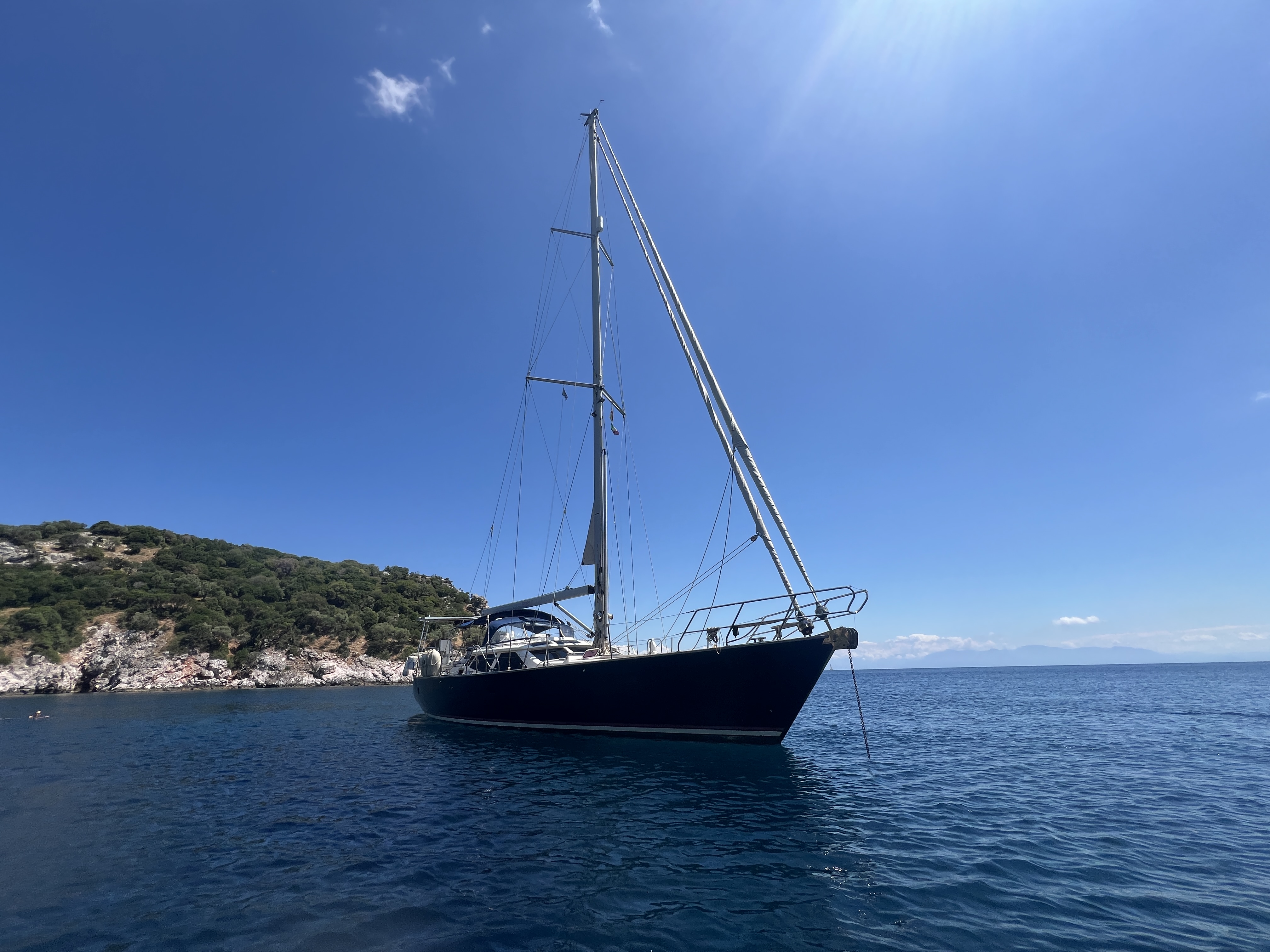
Our vessel for this voyage was Ticketeeboo, a Discovery 55 — Ron Holland designed, 17-metre blue-water cruiser built for serious offshore passage-making. Short-handed friendly, well-equipped, and a capable platform for a route like this.
The Euboean Gulf runs the length of a sheltered inland sea, largely protected from the prevailing Meltemi by the Evia ridge, with minimal fetch and manageable conditions even in mid-summer. The trade-off is distance and one operationally significant choke point: the Evripos Strait at Chalkida, where an opening bridge transits only at slack water — a window that lasts eight minutes and cannot be reliably predicted far in advance.
Get the Chalkida timing right and the rest of the route largely manages itself. This guide covers the passage in full — navigation, anchorages, berthing, and the specific things worth knowing before you go.
Leg 1 Zeas Marina to Porto Buffalo — ~45 nm
Expect light airs leaving Athens, particularly in the South Euboean Gulf. The first miles are frequently motored — tack around the headland south of Piraeus and head north-east into the gulf. Wind typically builds as the day progresses but the fetch remains short and conditions are manageable. Aim to reach Porto Buffalo by early evening.
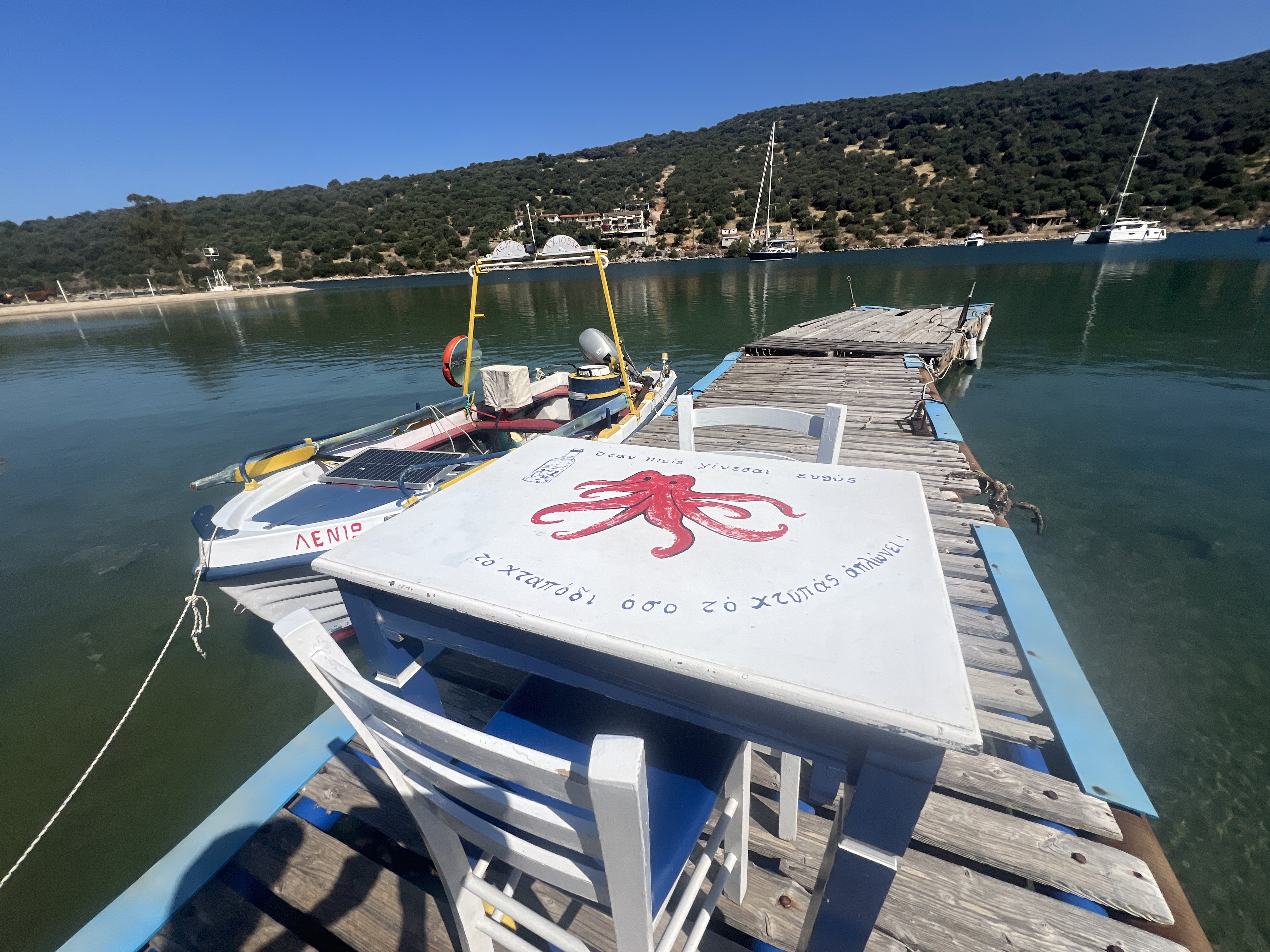
Buffalo Cove is a quiet anchorage on the Evia coast that sees very little charter traffic. Holding is reliable, the bay is well sheltered, and it functions well as a first overnight stop — close enough to Athens to be a reasonable first day's passage, far enough to feel like the trip has properly started. There is a small taverna ashore but no services of note. Provision in Athens before departure.
Leg 2 Porto Buffalo to Chalkida — the bridge passage ~35 nm
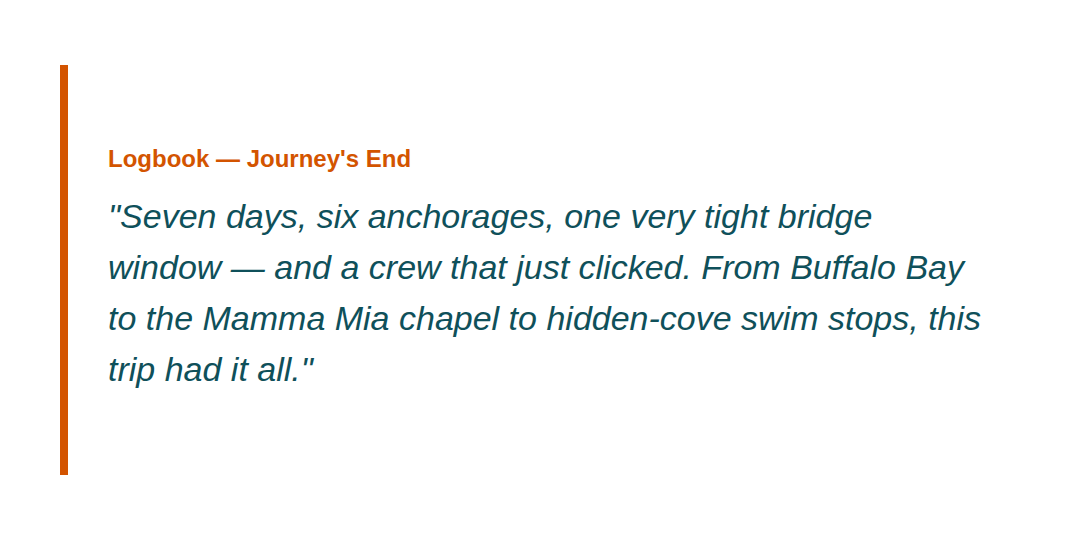
We headed 277° through the Euboean Gulf under sail, 6–8 knots on a broad reach. The gulf was quiet — two Eretria to Oripos ferries crossing at one point, kite surfers clustering at the channels' first narrowing. The high bridge appeared well before Chalkida: 34 metres clearance, 395 metres span, cable-stayed, completed in 1993. Greece's first of its type. We passed under it without incident.
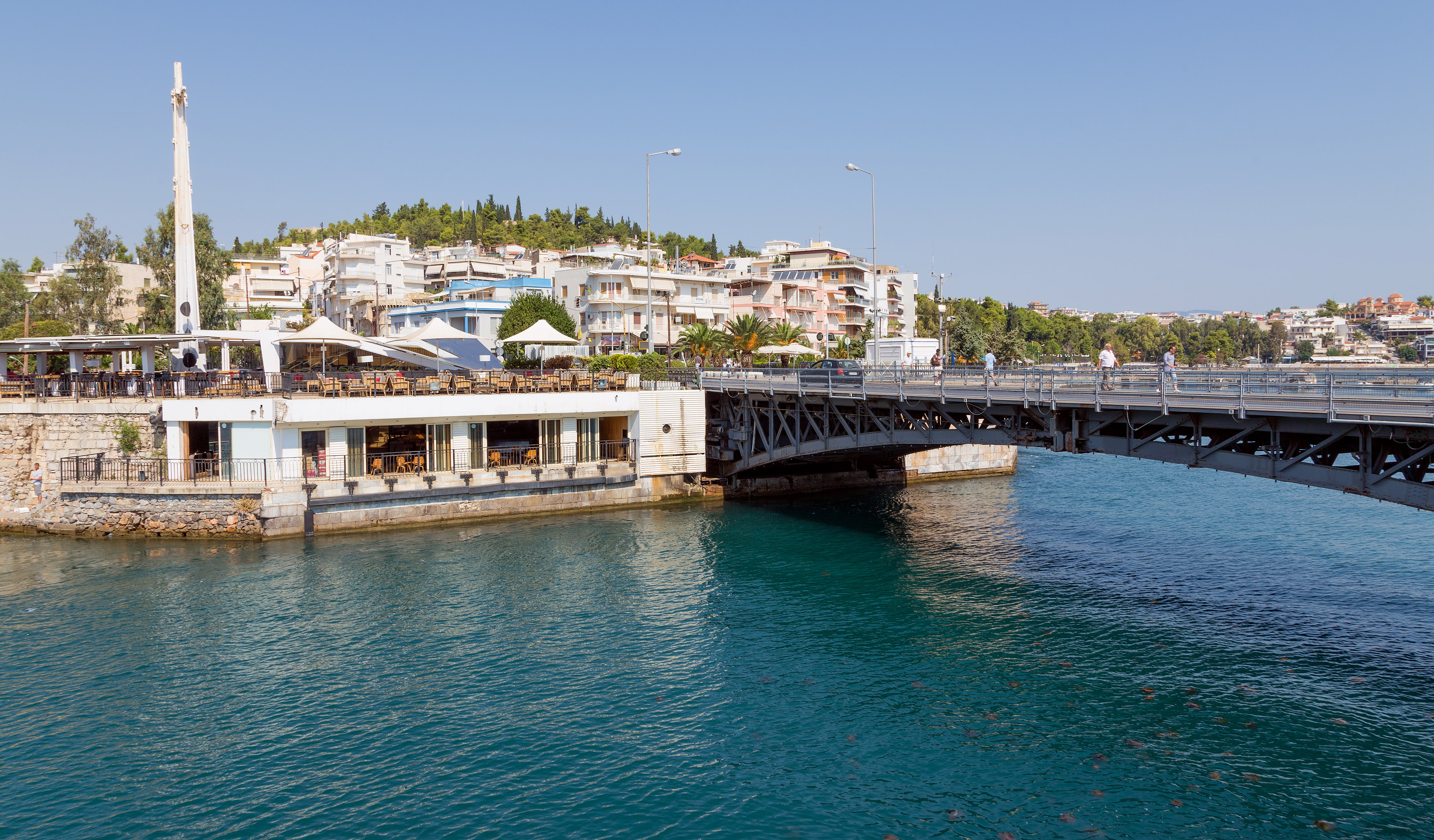
Once in the basin, we headed to the customs house on the south-east side of the channel, moored alongside the waiting wall, paid the toll, and moved to anchor with the other yachts sitting out the tide till the amber sunset faded. Our expected bridge lift window was 2200-2300 hours with margin either side. We got the radio shout at 2215hrs with a 5 minute pre-warning to prepare for passage. In turn, 8 boats funnelled through the narrowing and within just a few minutes it was all over and we were out the out other side with people lining the walls above to cheer us through.
What the Evripos Strait actually does
The Euripus Strait is the narrowest section of the channel separating Evia from mainland Greece. The tidal current here reverses approximately four times a day — not because of a standard tidal pattern, but because the North and South Euboean Gulfs operate on different tidal cycles. At peak flow, the current runs at 5–8 knots. Slack water, when the bridge opens, lasts 8 minutes. That window is the only viable transit time for a yacht.
Chalkida is a fully functioning city of 100,000 people. Use the wait productively: good chandlery, solid provisioning, and fuel available. It is the last reliable provisioning stop before the North Euboean Gulf villages, which offer little in the way of services.
Leg 3 Chalkida to Oreoi — North Euboean Gulf ~30 nm
Through the bridge and the character of the passage changes. The North Euboean Gulf is narrower, quieter, and sees almost no charter traffic. The fetch is short, the Meltemi largely blocked by the Evia ridge, and conditions are typically benign. This is the stretch of the route that justifies taking it.
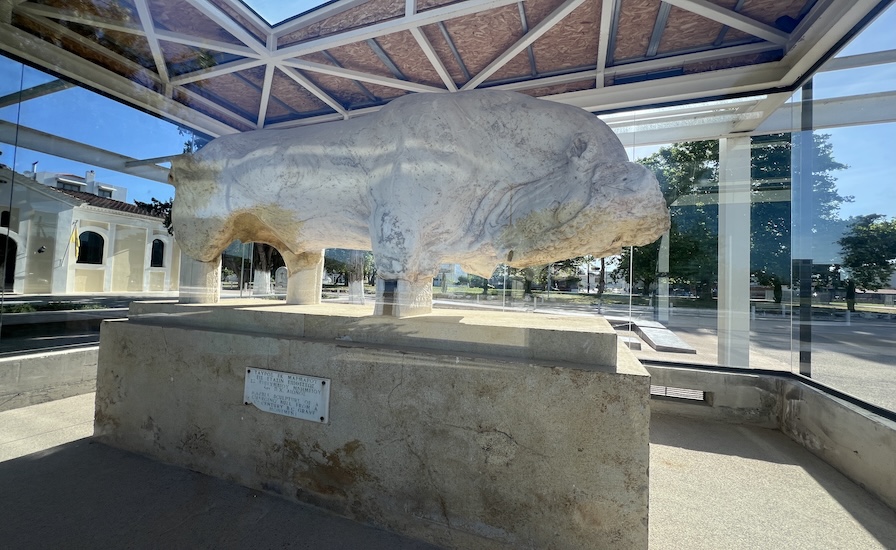
Oreoi sits on the northern tip of Evia. The quayside at Esione is a straightforward tie-up with reasonable shelter. The village is worth an hour ashore — there is a 4th century BC marble bull on permanent display, 4.8 tonnes, recovered from the sea floor by a local fisherman. It is one of the more significant pieces of ancient sculpture you will encounter on a passage stop and most sailors walk straight past it.
Top up water here. Provision if needed. The next reliable stop for both is Skopelos.
Leg 4 Oreoi to Agios Ioannis ~43 nm
Departed Oreoi at 1140hrs. Glassy water for the first four miles before picking up a solid beam reach on starboard — 6 knots on gib and main, engine off for the bulk of the passage. Lunch underway as we approached Nisida Beach, a ferry-serviced resort bay on the Evia coast where excursion boats drop day-trippers at the beach bar. A worthwhile hour's stop — swim ashore in clear water, then press on. Depths become unreliable on the approach so watch your chart carefully. From Nisida, head north-east across to the Skopelos north-east coast and the sheltered bay below the Agios Ioannis chapel rock. Anchor north of the rock. Overnight here — tour boats arrive from 1000hrs the following morning so climb steps pre-breakfast.
Agios Ioannis — anchorage and the chapel
The chapel of Agios Ioannis sits on the north-east coast of Skopelos, perched on a rock 100 metres above the sea. It is the filming location for the wedding scenes in Mamma Mia and draws significant tourist traffic as a result. There is a small sheltered bay to the north of the rock that provides reasonable overnight anchorage — arrive by late afternoon to secure a good position before tour boats depart and the bay quietens.
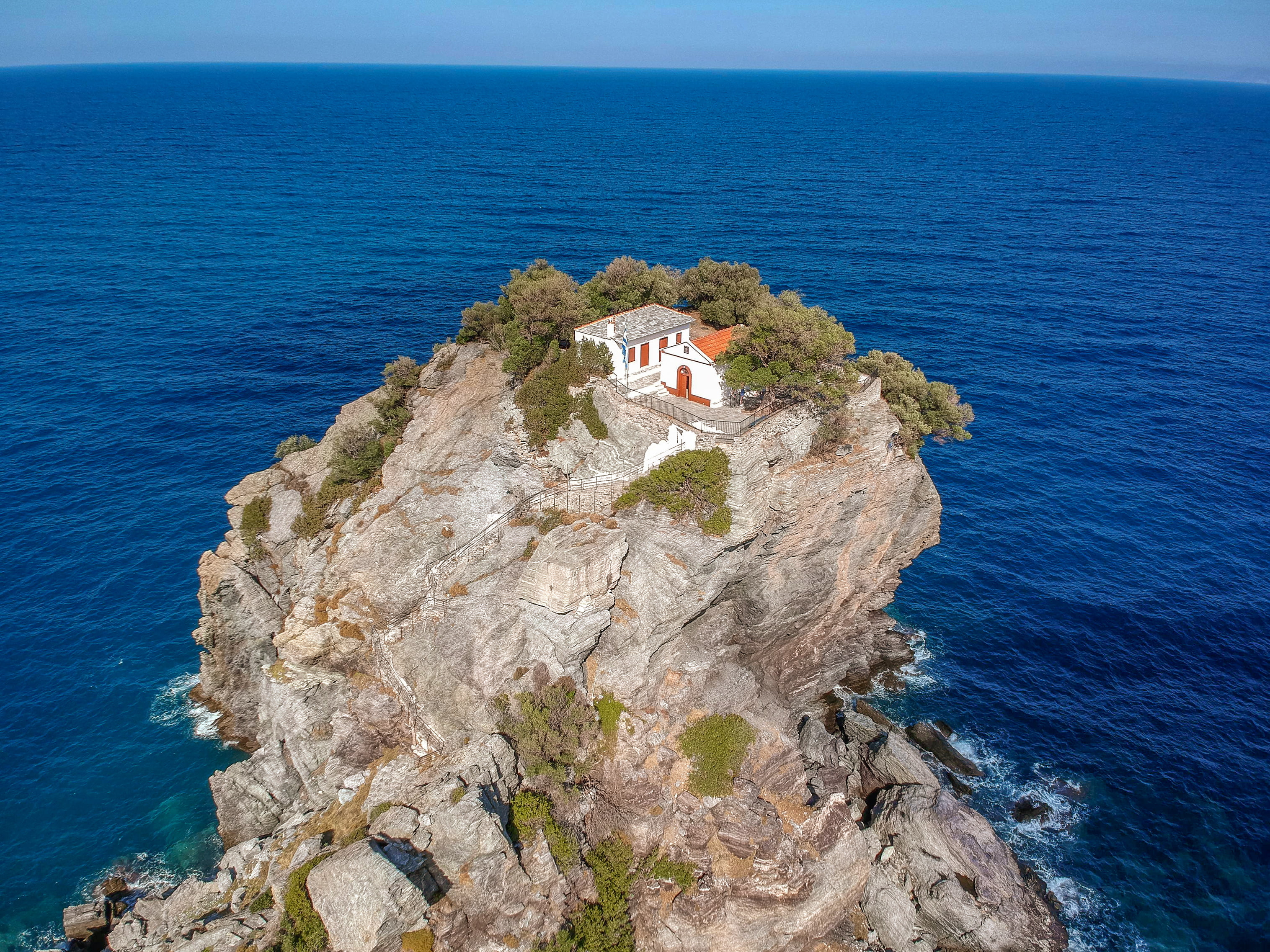
There are 198 stone steps cut into the rock to the chapel at the top. The views from the summit are worth it: open Aegean, rugged coastline, the anchorage directly below. The bell at the top works. Tour boats begin arriving from around 1000 — if you want the climb to yourself, go at first light and be back on the boat before the bay gets busy.
The beach at the base of the rock is accessible from the anchorage by swim or dinghy. It becomes crowded during the day when excursion boats are running. By early evening it clears.
Leg 5 Agios Ioannis to Patitiri (Alonnisos) ~18 nm
Departing just after 1000hrs on heading 120°, the southerly breeze offered little shelter along the south-west bays of Alonnisos so we pushed on round to Patitiri town and moored stern-to on the quay. Patitiri is the main port of Alonnisos — busier than anything on this route so far, with tourist boats and ferries arriving steadily through the day. Worth a walk ashore to get a feel for the island, but not a place to linger if you're after quiet. A slow-creeping thunderstorm held us in the afternoon — springs added to stern lines as we moored between other boats on this quay as the wash builds quickly. We stayed on board conscious that all the other sailors had left to storm-watch from the quayside cafes, leaving us to mind the commotion. By evening the weather had cleared and the marina settled.
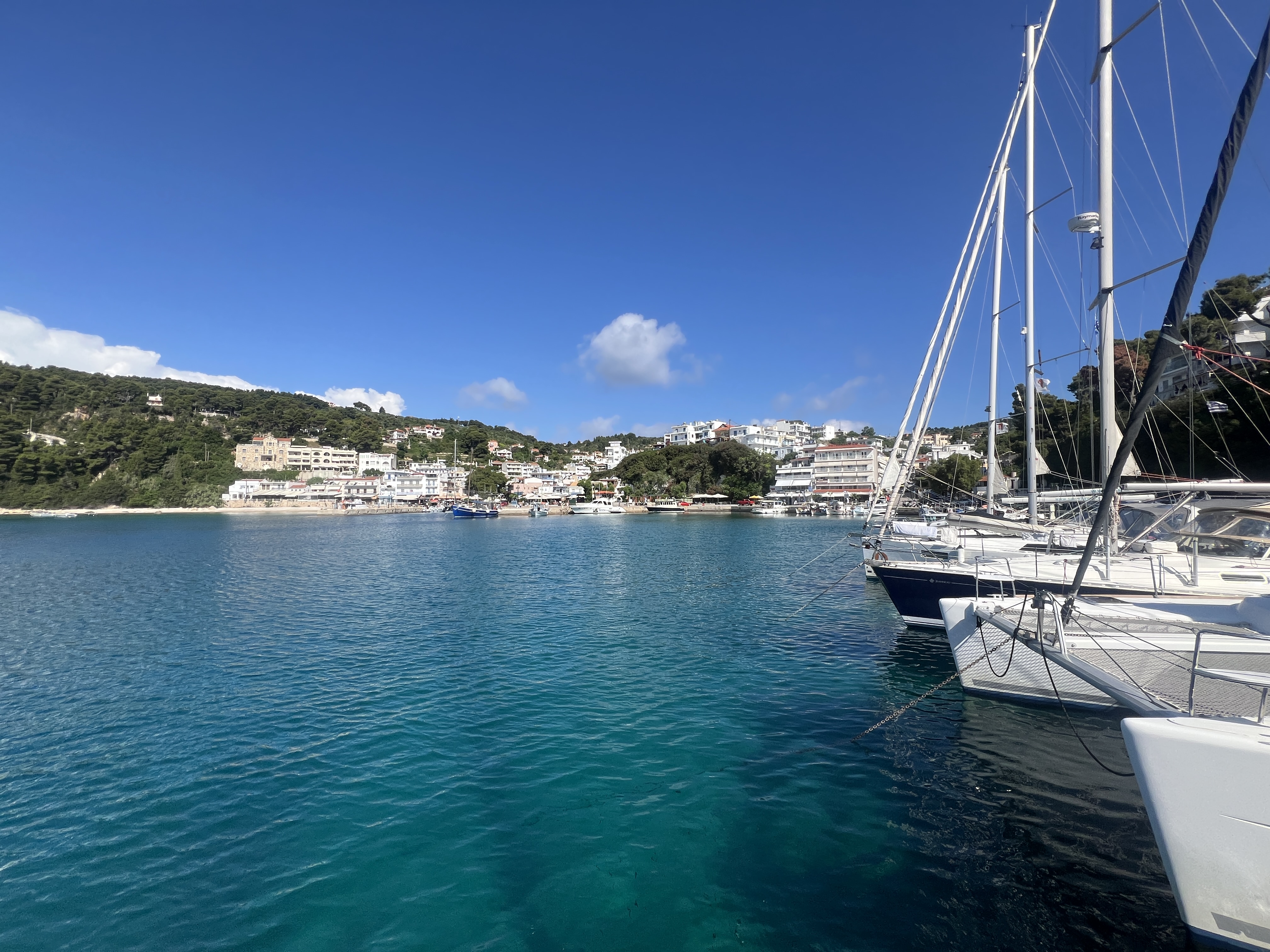
Leg 6 Patitiri to Skiathos — final approach and Town Quay — ~20 nm
Stafylos Bay on the south-west coast of Skopelos is a natural intermediate stop before Skiathos — clear water, sand holding, unspoilt. Anchor, swim, and depart when ready. It is a 12 nm crossing from Stafylos to Skiathos in open water.
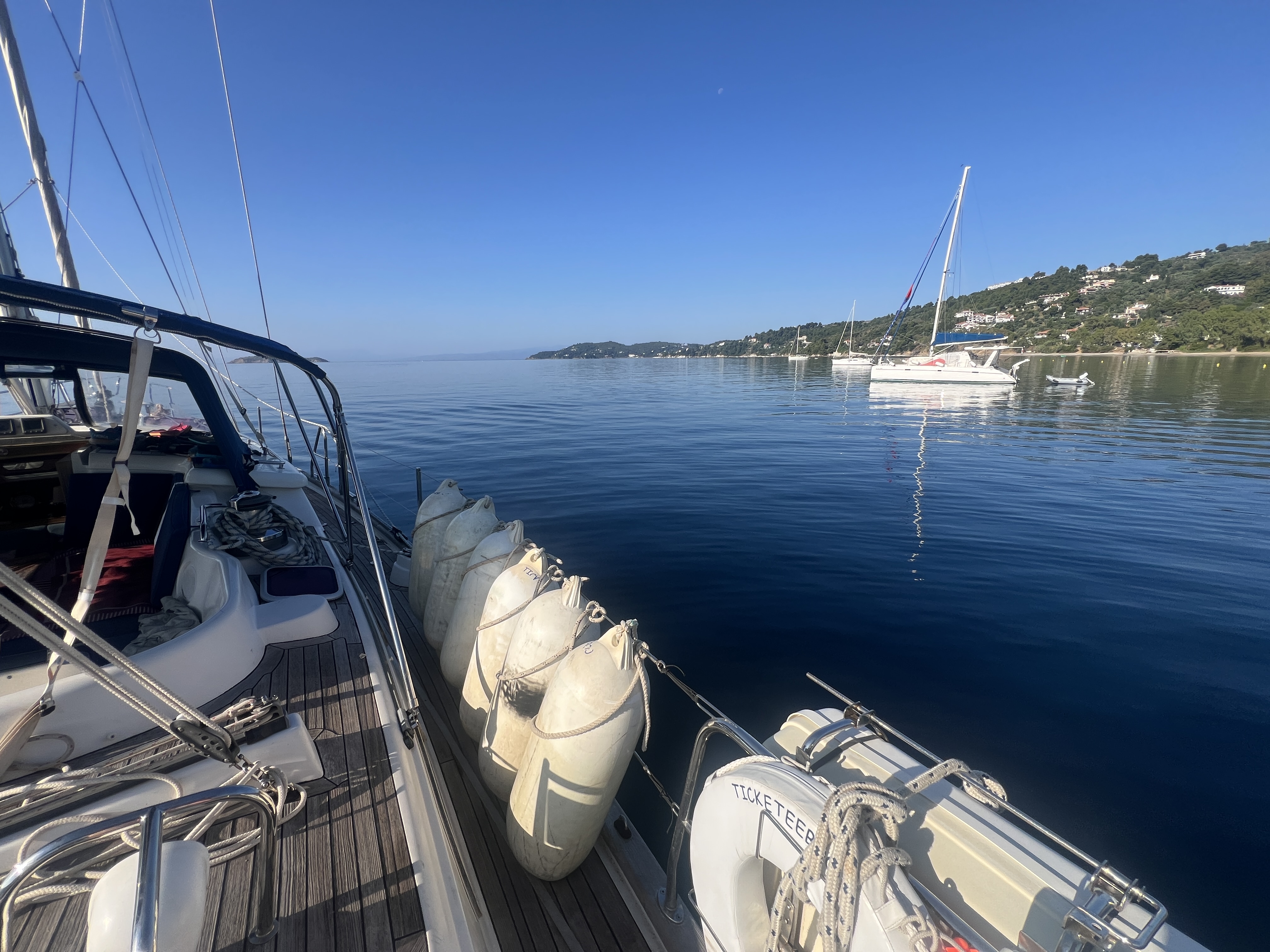
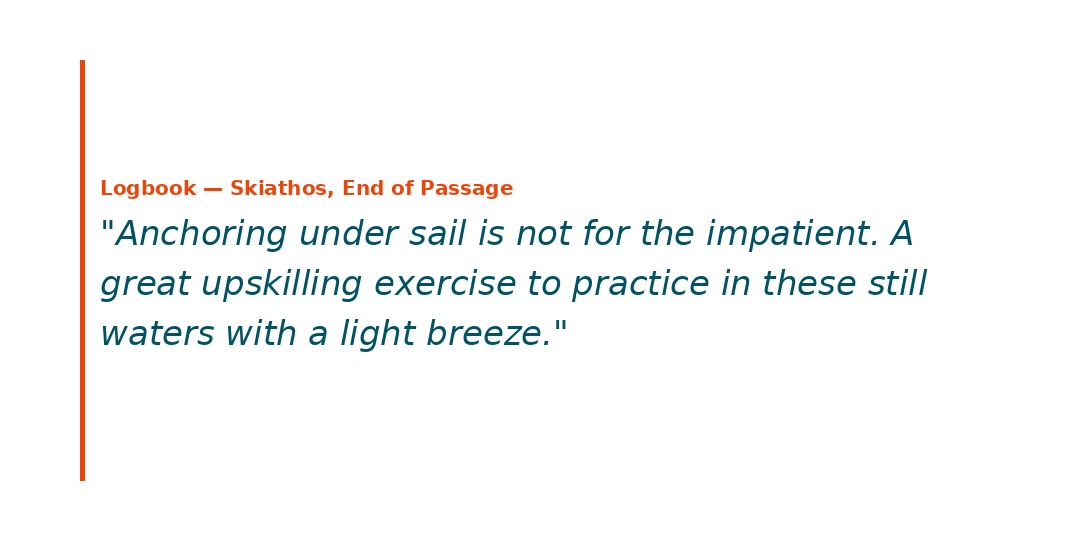
Paralia Megali Ammos on Skiathos is worth noting as an anchorage before committing to the town quay. The approach under mainsail only is achievable when conditions are light — a useful exercise for any crew looking to extend their boat-handling skills.
Skiathos Town Quay
Skiathos town is busy. Navigate past tourist and ferry traffic to find your berth — reverse stern-to with adequate chain out, typically 25 metres in the available depth. There is consistent wash from the large ferry operating to the north of the quay. Brief your crew before approach and consider adding springs once berthed. This is standard Greek quay technique but the ferry wash at Skiathos is more significant than most.
Skiathos marina and town are well-equipped: fuel, water, provisioning, basic repairs, and strong connectivity. It is the logical crew-change point with Europe's shortest runway neighbouring the port and the natural end of this passage.
With thanks to Peter Coxon, owner of Ticketeeboo and SailTies - the best digital logbook app for journaling sailors.
About Claire Lindquist
Owner and creator of True North Yachts with a passion for getting people out on the water safely. I have sailed as a liveaboard, a cruiser and a racer, from dinghies to bluewater yachts. I have technical background in the industry and a curiosity for boating innovations as well as an appreciation for classic crafts. When ashore you'll find me in boatyards, usually up a mast or crammed into an engine room. Away from boats, I recharge with coastal walks which keeps me grounded and always connected to the sea.