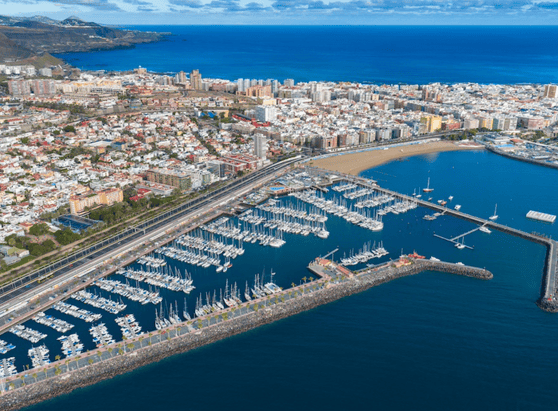
On 22 November, the ARC fleet crosses the start line off Las Palmas de Gran Canaria, bound for Saint Lucia, as it has every November since 1986. Most of the boats are family cruisers, crewed by people who once stood on the shore and decided that next time it would be them. If you're following this year's fleet and thinking about ARC 2027, the boat you choose this winter is the biggest decision you'll make. Here's how to choose well.
"Bluewater" describes how a boat copes with risk more than what type of boat she is. Offshore, things will break. What counts is what happens when they do, how far you are from help, and whether the crew can deal with it alone.
That changes how you should buy. Instead of ticking off a kit list, ask three questions of every system: how can it fail, is there a backup, and can you fix it at sea with what's on board? Comfort in a seaway matters as much as strength, because a boat with a violent motion wears the crew down long before she is in any structural danger. And track record matters, because a boat that has already done the job answers questions that design figures can't.
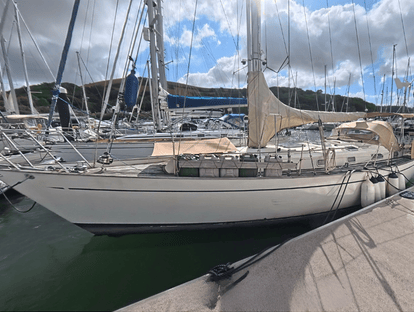
This piece puts Katinka, a 1991 Bowman 40 listed with True North Yachts and a veteran of ten Atlantic crossings, through that test. Each section explains what to look for and why, then shows how she measures up, including where a new owner would still have choices to make.
1. Hull, keel and rudder: where problems are hardest to fix
The underbody is where problems are hardest to fix at sea, so look past the paintwork. Ask how the keel is attached and supported, whether the area around the keel and rudder has been inspected, and what stability data exists. The angle of vanishing stability, the angle of heel beyond which a boat won't right itself, is the most useful single figure for comparing offshore boats; ask the builder or class association if they have it.
Rudder type is a real trade-off. A spade rudder gives a lighter helm and points higher, but the whole load hangs off the rudder stock, and if you hit something it takes the full blow. A skeg-hung rudder is supported at the bottom as well, has its leading edge protected, and helps the boat hold a straight course, which also makes a wind vane's job easier. The downside is less nimble handling under engine in tight marinas, which most ocean sailors happily accept.
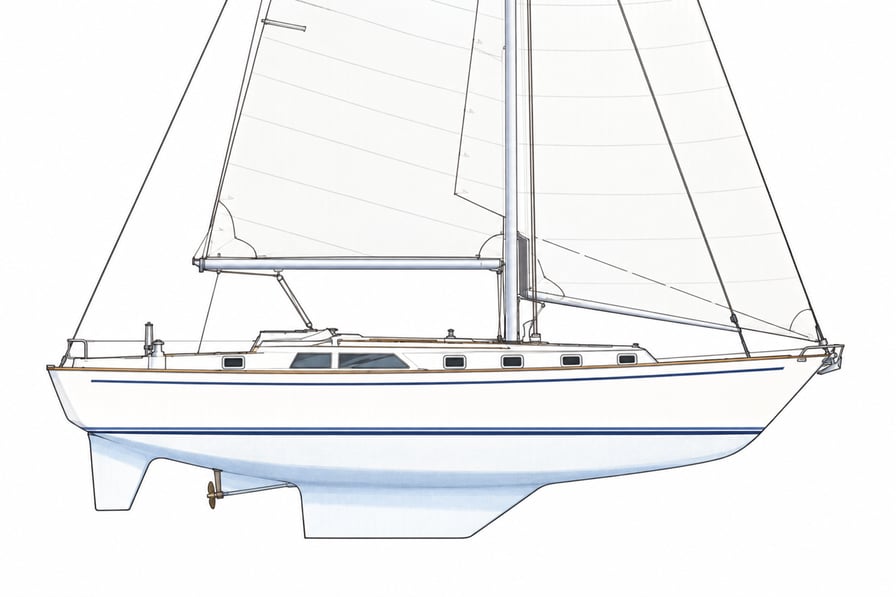
Katinka: The Bowman 40 was drawn by Chuck Paine for open water and built by Rival Bowman in Southampton, with fewer than 60 completed. Katinka is hand-laid GRP with a heavily ribbed structure. Her skeg-hung rudder is fully protected, with no gap for lines or nets to foul. The underwater hull was given an eight-coat epoxy barrier against osmosis in 2002. Any buyer's surveyor will still want to sound the hull and inspect the skeg and rudder bearings, as on any boat of this age.
2. Rig: strong, storm-hardy and crew-serviceable
Rig failures offshore rarely come out of nowhere. They usually start with a tired terminal or a cracked fitting nobody checked. So the question isn't just how strong the rig is, but how much stronger it is than it needs to be and whether you could fix it yourself in a remote anchorage.
A cutter rig earns its place offshore through flexibility. Roll away the yankee, sail on staysail and reefed main, and the sail plan gets smaller and lower, the boat heels less and stays balanced, all without anyone going onto the foredeck. Double spreaders give the mast better support. On wire rigging, swaged terminals can crack on the inside where you can't see it; swageless terminals can be assembled, checked and remade with hand tools.
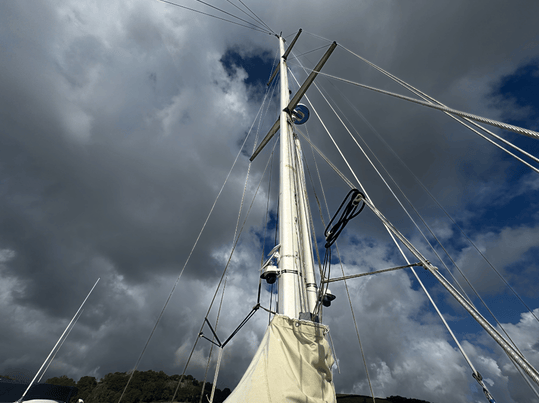
Katinka: A double-spreader cutter with twin backstays. Her standing rigging has been upsized to 8mm and 10mm wire, increasing the safety margin over standard, with Sta-Lok swageless terminals throughout. Enough spare 8mm and 10mm wire to replace a stay is carried, along with cutters and a tension gauge, and the terminals need no swaging tools, so a failed shroud is a repair job rather than the end of a passage. Fully battened main with three reefs, yankee and staysail on Harken and Furlex furlers, twin adjustable lazy jacks, and running rigging renewed in 2023.
3. Self-steering and navigation: always have a backup
Think of self-steering as a question of power and reliability. An electric autopilot running around the clock is usually the biggest drain on an offshore boat's batteries, and if it fails, a two-person crew is hand-steering within hours. A wind vane uses no power, steers to the wind rather than a compass course, and can usually be repaired with spares and basic tools. It struggles in light winds dead downwind and under engine, which is why many crews carry both and treat the vane as the main system.
The hull plays a part too. A boat that holds her course with a balanced helm, which a skeg-hung rudder helps with, makes the vane's job far easier than a twitchy, lightly-keeled design.
Navigation works the same way. GPS is accurate but needs power. The test is simple: could you still find your position and steer a course with every screen dark?
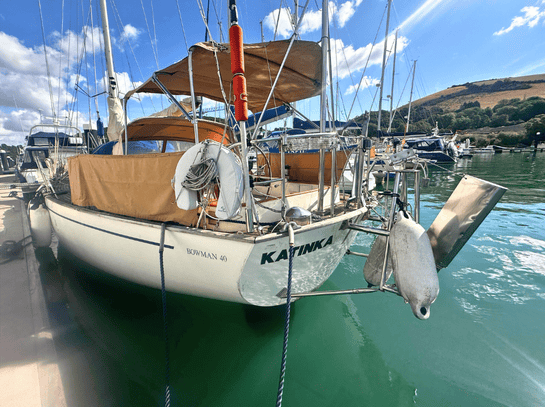
Katinka: A Monitor wind vane, all-stainless and fitted in 1998, with spares aboard. Electronics are GPS, AIS and VHF with an OpenCPN chart plotter, backed up by Rigel and hand-bearing compasses and a Visiball radar reflector.
4. Self-sufficiency: water, power and communications
Offshore, you only have what you carry and what you can make. Think of it as a budget: what's in the tanks, what you can generate, and what you use each day. The number that counts is how many days you can last, not litres or amp-hours on their own.
For water, several tanks beat one big one, because a single tank means a single contamination risk. For power, a mix of sources beats one large one, since solar and wind work best in different conditions. Battery type matters too: lithium (LiFePO4) batteries can be drained much further than lead-acid without damage, so a smaller bank gives you more usable power. For comms, SSB radio has no airtime charges and doesn't depend on satellites, though it takes more learning; many crews now carry a satellite system alongside it.
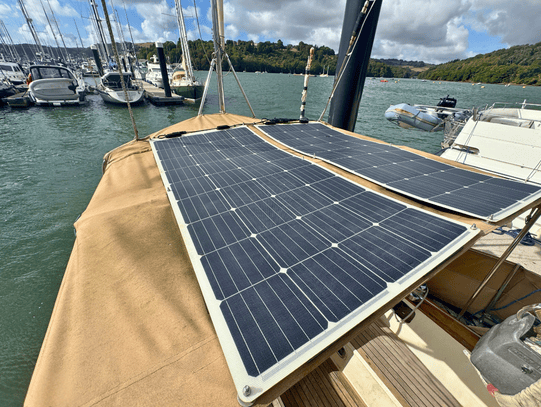
Katinka:
- Water: 545 litres split across three removable stainless tanks, deck fillers positioned to harvest rain, and a PUR Survivor-35, a hand-operated emergency watermaker intended as a survival backup rather than a primary supply.
- Fuel: 320 litres
- Generation and storage: 2 x 160W solar and a KISS wind generator rebuilt in 2025, feeding 2 x 170Ah LiFePO4 batteries via CTEK MPPT charging (2020); a 1kW inverter; a Victron isolation transformer, which breaks the shore-power earth path that drives galvanic corrosion in marinas
- Comms: Icom IC-M700 Pro SSB with AT-130 tuner, insulated backstay aerial, KISS ground plane and SCS Pactor modem for SailMail email and GRIB weather files
- Heat and cooking: propane stowage for five bottles and a wood-burning stove fitted in 2017, which extends her range into cold-water cruising
A buyer planning extended passages may want to add higher-bandwidth satellite connectivity; the SSB installation provides a robust, cost-free fallback beneath it.
5. Ground tackle: holding power is a system
Cruising boats spend far more nights at anchor than at sea, and dragging in an exposed anchorage is one of the more common ways boats are lost. Holding power depends on the whole set-up: anchor type and weight, the chain, how much you let out, and a windlass that can pull it all back in when it's blowing.
Two things are worth knowing. Anchor design has moved on: newer roll-bar and concave-fluke anchors generally set faster and more reliably than traditional ploughs in independent tests, and many owners upgrade their main anchor for that reason. And carrying more than one anchor isn't just about spares. A second bow anchor lets you lie to two anchors in poor holding or strong tides, and a kedge can pull you off if you run aground.
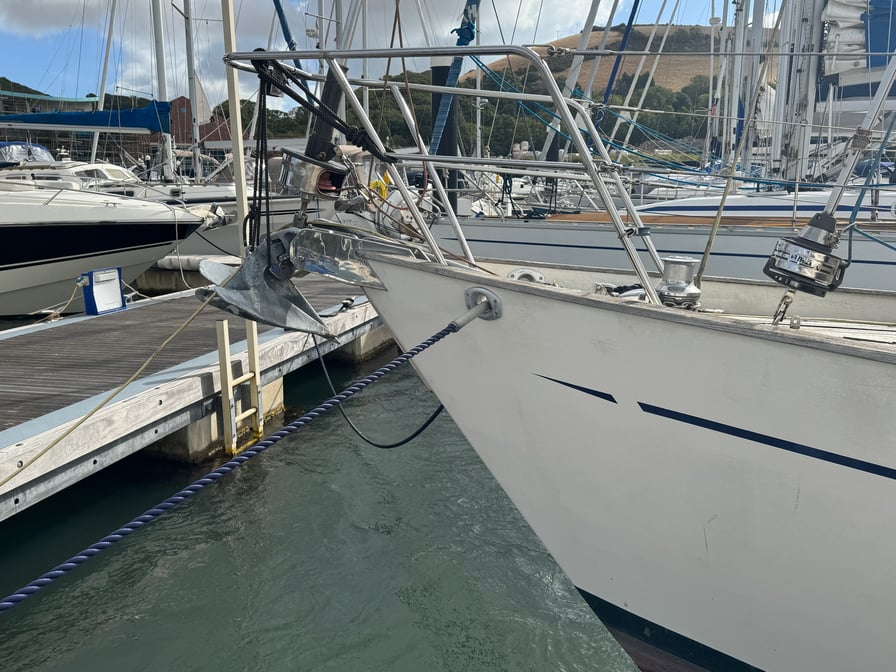
Katinka: 28kg and 20kg CQR anchors and a 15kg Danforth kedge, 54m of calibrated stainless chain, 160m of warp and an electric windlass. That is a generous inventory for a 40-footer. A new owner may still choose to swap the primary for a new-generation design, and should have the stainless chain inspected link by link, as with any stainless rode. Safety equipment includes fire blankets and extinguishers, a lifebuoy and danbuoy, new jackstays, an emergency VHF aerial, and smoke and CO detectors.
6. Engine: simple beats new
Offshore, the engine is your backup charger, your escape from a lee shore and your way through a calm. What matters is that it's simple, easy to get at and still supported with parts, in that order. A modern electronically managed engine is efficient, but an electronics fault is far harder to sort out in a remote anchorage than a fuel problem on a diesel with mechanical fuel injection.
If you can't get at it, it won't get serviced: if changing the impeller means taking the galley apart, it will get put off. Treat engine hours as one clue among several. Older tachometers drift, and hours spent charging batteries at low load wear an engine differently from hours under way. Oil analysis, compression tests and service records tell you more.
Where the engine sits matters as much as what it is. A diesel is one of the heaviest single items aboard, and weight in the ends of a boat makes her pitch harder and longer: once the bow or stern starts moving, the extra mass keeps it going, and a heavy bow drives deeper into a steep sea. Put that weight in the middle, low down, and the boat rises to the waves more easily, stays better balanced fore and aft, and is kinder to her crew in rough weather. A central engine also means a short shaft and room to work around it.
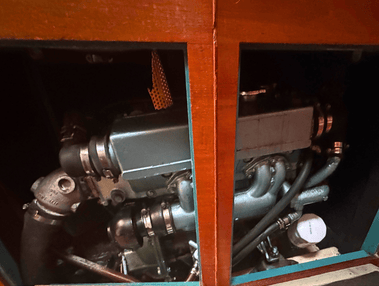
Katinka: A Perkins Prima M50 (50hp) with a Hurth 2.14:1 gearbox, mounted amidships under the galley, which keeps her heaviest single item low and central and gives a short, accessible shaft run. A comprehensive set of spares and manuals is included. As with any engine of this era, a buyer should confirm parts availability for the components they would want to carry offshore.
7. Living aboard at sea: a layout for tired crew
On a long passage, the crew usually tires before the boat does. A layout designed for marina living, with big open spaces and berths at the ends of the boat, puts people where the motion is worst just when they need to rest or work.
Picture the interior heeled at 25 degrees in a lumpy sea. Sea berths should be near the middle of the boat, where she moves least, and have lee cloths. The galley works best amidships too, with somewhere to brace on either tack. A proper chart table gives the person on watch a fixed place to work. On deck, wide side-decks and solid bulwarks make every trip forward safer. And two heads isn't a luxury when a blocked seacock is days from a chandlery.
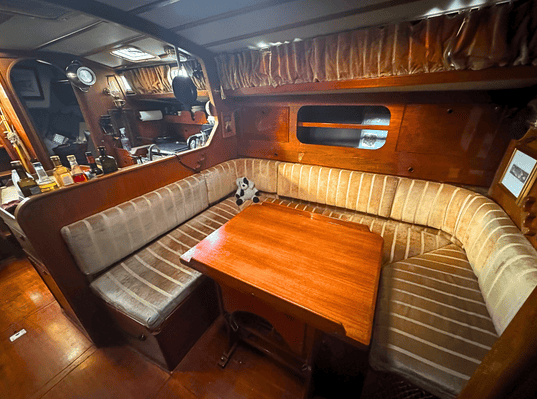
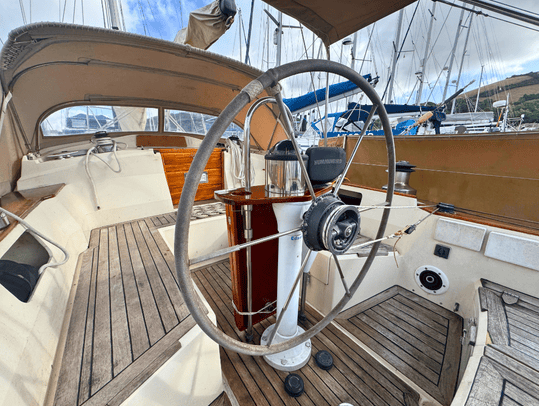
Katinka: Teak decks with capped bulwarks and wide side-decks. Below, teak joinery, two heads with showers, sea berths forward and aft, a dedicated chart table, and the galley amidships over the engine. Her owners report she has never been pooped in ten Atlantic crossings, which says a lot about how her hull and cockpit handle big following seas.
8. Track record and paperwork
A design's reputation tells you what that class of boat can do. A logbook tells you what this particular boat has been through, and her maintenance records tell you how she's been looked after since. On an older yacht, proven ocean miles are the closest you'll get to a real sea trial.
Paperwork is the other half, and since Brexit it can change what a boat really costs you. VAT status now depends on where you keep her: proof that EU VAT was paid matters if you plan to keep her in EU waters, while UK VAT status is a separate question that can depend on where the boat has been and which reliefs apply. Before committing to any older boat, gather:
- An unbroken bill of sale chain and ownership history
- Registration documents
- Original customs and VAT documentation
- Previous surveys and records of structural or major work
- Dated receipts for significant equipment
Take specialist VAT advice on your own plans before you exchange.
Katinka: Ten Atlantic crossings is the headline, supported by a clean, fully documented ownership history. Her file includes a 1993 Spanish customs import declaration from Málaga confirming EU VAT was paid on importation, a previous survey, and dated records of the upgrades set out above.
Every criterion above comes back to one question: what happens when something goes wrong a thousand miles from help? The right boat has answered it before she leaves the dock. Which boat that is depends on where you are going and who is coming with you, but the economics hold regardless. Converting a coastal boat for ocean work almost always costs more and takes longer than planned. Start with one that already passes most of these tests, and has proved it many times over, and the budget goes on the upgrades you want rather than the ones you need.
Timing matters too. Buy this winter and you have a full season to learn the boat, make her your own and put miles under her keel before the ARC 2027 fleet gathers in Las Palmas next November.
Katinka has already done the hard part ten times. She is listed at £94,995 and lying in Kingswear, Devon. For the full specification or to book a viewing, contact True North Yachts on 07777 712707.
For full listing got to Katinka Bowman 40

About Claire Lindquist
Owner and creator of True North Yachts with a passion for getting people out on the water safely. I have sailed as a liveaboard, a cruiser and a racer, from dinghies to bluewater yachts. I have technical background in the industry and a curiosity for boating innovations as well as an appreciation for classic crafts. When ashore you'll find me in boatyards, usually up a mast or crammed into an engine room. Away from boats, I recharge with coastal walks which keeps me grounded and always connected to the sea.